
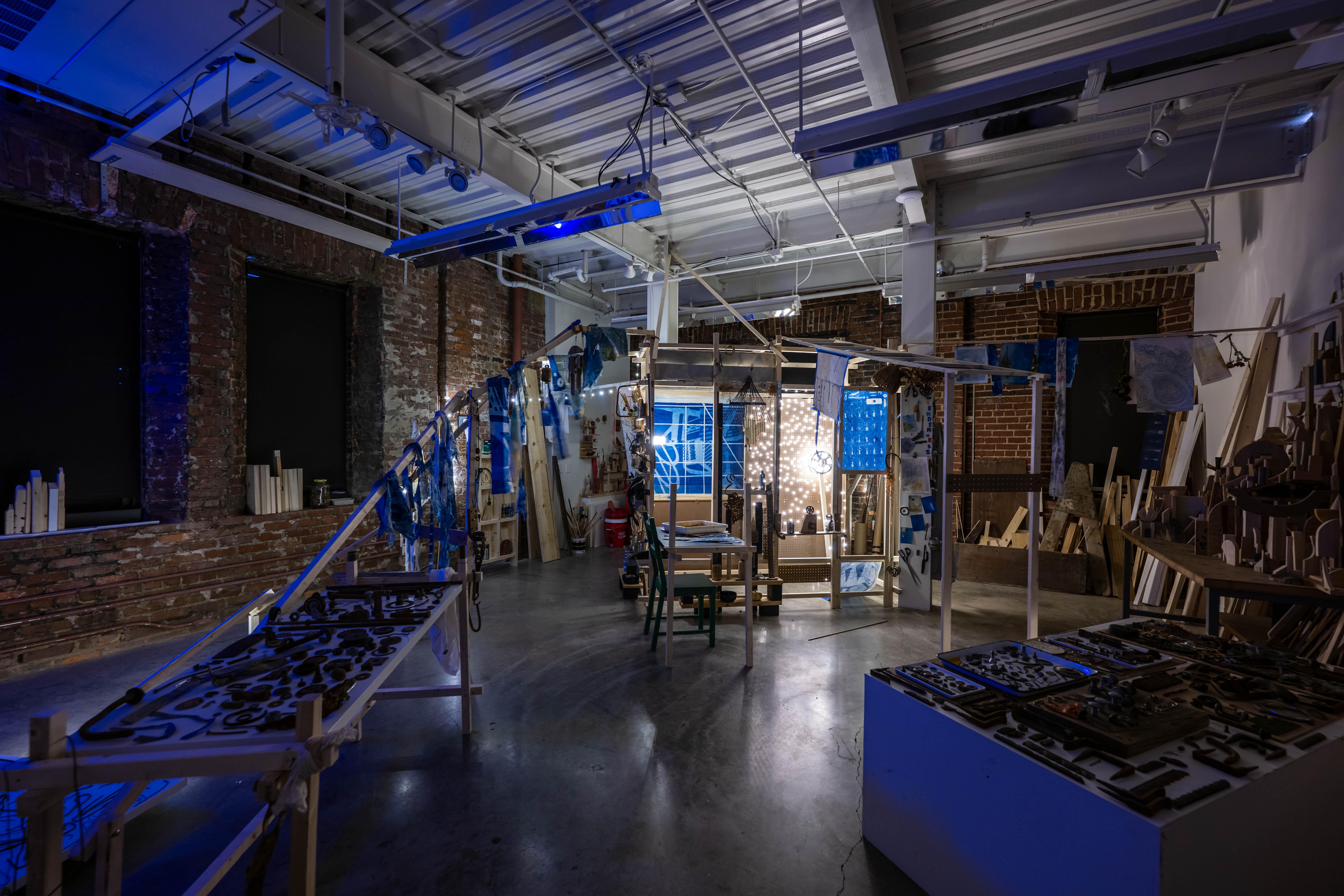
As I wandered through McColl Center, my mind still tangled in the chaos of daily life, I stumbled upon Jason Lord’s installation by accident. Aware that he was working on something tucked away in a back room, I hadn’t realized it was complete. I could hear sounds that I assumed were Jason working, and what I intended as a brief hello quickly turned into an arresting experience for my senses and spirit.
"A Tender House of Echoes" unfolds like a sanctuary. The room is bathed in a low, warm glow from strands of lights. Cyanotype panels are illuminated like paper lanterns. Wind chimes are stirred by the soft exhale of an AC unit.
What makes this installation truly special is the palpable presence of Jason himself. Behind the central structure, there’s an area filled with sketches, scrap paper, and artifacts of his creative process. This glimpse into his studio space imbues the installation with a sense of the artist’s hand and presence, even when he’s not there. Jason’s comforting specter lingers in the room.
This sense of presence is further deepened by personal and collective echoes. For instance, a tray from the Printmaking Studio holds the pot liquor of what Jason called “rust soup,”, and even a green-painted chair that I once kept in my apartment finds new meaning within this work. A peel from a shared orange shrivels, and falls. Humidity peels back painter’s tape and paper wilts, a subtle, scraping sound. These elements create a tapestry of shared experiences, underscoring the theme of interconnectedness and transformation.
What Jason is ultimately shaping is not just material, but time itself. Objects pulled from durational contexts - a can weathering beside a railroad for an unknowable timespan, a surface marked by slow exposure to UV light - arrive here stripped of a linear chronology. Past use, present arrangement, and future potential collapse into one another. Douglas Rushkoff describes this phenomenon as the “winding” of time, where the boundaries between then, now, and next blur, often producing a sense of disorientation or bodily disruption. Jason, however, resists treating this collapse as a pathology. Instead, he leans into its generative potential. While a Hegelian framework might suggest a tidy progression (thesis meeting antithesis, resolved through synthesis, like the clean physics of a thunderstorm forming from opposing air masses), Jason’s work refuses such conclusion. The collision here does not resolve; it accumulates. Time folds rather than advances, and meaning emerges not from fusion but from sustained friction. In this way, the installation aligns itself with a metamodern sensibility: earnest without being naïve, unresolved without being cynical, holding contradiction not as a problem to be solved, but as a condition to be inhabited.
Jason’s influences are also evident, with nods to Felix Gonzalez-Torres and Keith Haring. Like Gonzalez-Torres, Jason weaves themes of grief and loss into his work, while his gesture to Keith Haring’s unfinished works emphasizes the beauty of imperfection and the ongoing process of creation.
I find myself visiting this installation often, seeking reprieve from busy days, craving a place to ground myself. It is a shelter. A particularly striking moment occurs when a tour group enters the room. I am not in view, behind the main structure, and I notice that as they step inside, their laughter and chatter give way to hushed tones, a testament to the profound, reverent atmosphere Jason has created. It’s a powerful reminder of how the installation arrests the senses and evokes awe.
One cannot help but notice Jason’s obsessive care and attention to detail. I was never great at those “guess how many jelly beans are in the jar” games, but it feels like there are easily 1000+ objects in this room. However, somehow it does not feel chaotic. Wood is arranged on window sills, like books, and also in an altar-like shrine. It puts the “tinder” in “tender.” Lord intentionally evokes the shape of a church window, both drawing on McColl Center’s architecture due to its past life as a church, and also his Catholic upbringing. Maybe that’s part of why something about this work feels holy.
I find myself visiting this installation often, seeking reprieve from busy days, craving a place to ground myself. It is a shelter. A particularly striking moment occurs when a tour group enters the room. I am not in view, behind the main structure, and I notice that as they step inside, their laughter and chatter give way to hushed tones, a testament to the profound, reverent atmosphere Jason has created. It’s a powerful reminder of how the installation arrests the senses and evokes awe.
In this way, "A Tender House of Echoes" becomes more than just an art installation; it’s a reflection of how we influence and carry each other forward. It’s a celebration of the artist’s presence and the collective journey we all share, honoring both the past and the transformations to come.